
Strength & Conditioning for BJJ Hobbyists: Finding the Sweet Spot
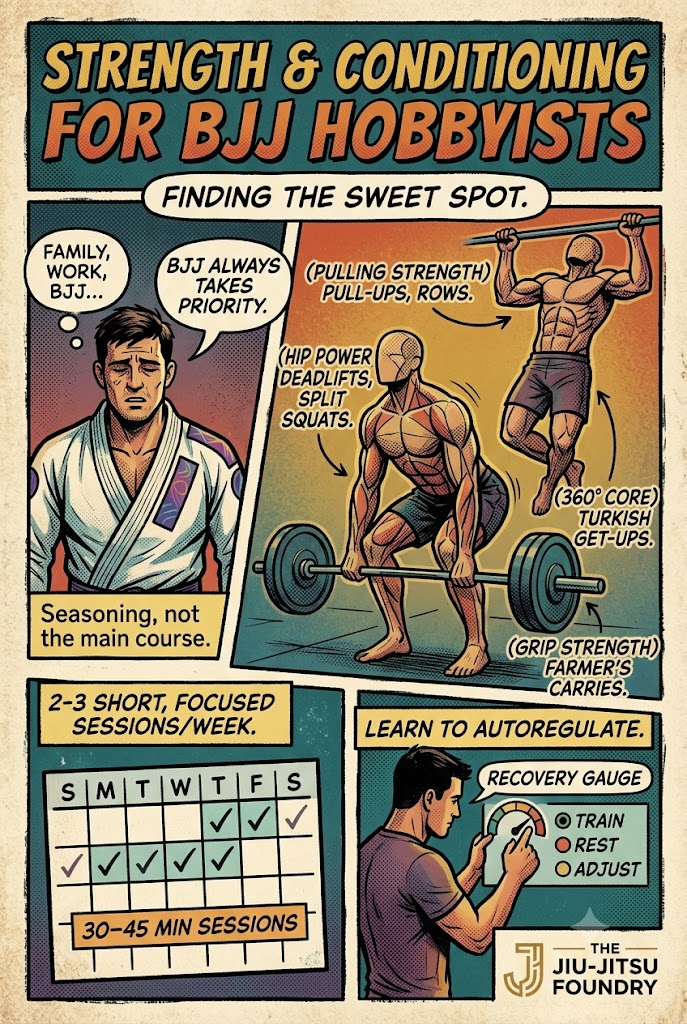
How much strength and conditioning should a BJJ hobbyist actually be doing? It's one of the most common questions on the mats — and one of the most consistently overcomplicated answers online.
The short version: enough to make you stronger and more resilient on the mats, not so much that you show up exhausted to class. Here's how to find that line.
You're Not a Professional Athlete — Train Accordingly
Most BJJ practitioners have jobs, families, and real-world obligations. They train two to four times a week and want their strength work to complement their jiu-jitsu — not compete with it.
Professional athletes train under full-time recovery protocols. You don't have that luxury. Showing up tired to BJJ class doesn't just hurt your performance — it slows your technical development, which is the entire point of being there.
The foundational principle is simple: BJJ always takes priority. Think of S&C as seasoning on a meal. It enhances the main course. It doesn't replace it.
Why Strength Training Still Matters for Grapplers
Done correctly, S&C work delivers real returns for BJJ practitioners at any level:
Injury prevention is the most underrated benefit. Stronger muscles, tendons, and ligaments handle the demands of grappling more resiliently — especially as you age or increase training volume.
Performance under fatigue is where strength shows up most visibly. Technique is king, but when you're tired in round four, extra horsepower helps you execute what you already know.
Recovery between sessions improves with consistent resistance training. Better tissue quality and circulation means you bounce back faster — which means more quality mat time overall.
How Much S&C Should a BJJ Hobbyist Do?
For most recreational practitioners, two to three sessions per week is the sweet spot. Scale it against your BJJ volume:
Training BJJ 2x per week → 2–3 S&C sessions
Training BJJ 3x per week → 2 S&C sessions
Training BJJ 4x per week → 1–2 S&C sessions
As BJJ volume goes up, S&C volume comes down. Keep sessions 30–45 minutes — short, focused, and purposeful. You're training to be a better grappler, not a powerlifter.
What to Train: The Four Priorities for BJJ
Pulling strength — BJJ is a pulling-dominant sport. Build it with pull-ups, rows, and lat pulldowns.
Hip power and stability — your hips generate force in almost every position. Deadlift variations, hip thrusts, and single-leg exercises (Bulgarian split squats, lunges) are your foundation here.
360-degree core stability — not just abs, but bracing capacity in every direction. Planks, dead bugs, Pallof presses, and Turkish get-ups all transfer directly to grappling.
Grip strength — consistently undertrained and consistently punishing when neglected. Farmer's carries and plate pinches are simple and effective.
A Simple Weekly Template
A straightforward structure for someone training BJJ three times per week:
Monday: BJJ
Tuesday: S&C — upper focus (pulling, core)
Wednesday: Rest or light mobility
Thursday: BJJ
Friday: S&C — lower focus (hips, legs, grip)
Saturday: BJJ
Sunday: Rest
Adjust based on your actual schedule. The principle matters more than the specific days.
The Minimalist Option
Short on time or just getting started? This bare-minimum approach still delivers meaningful results:
Session A (2× per week, 30 minutes): Pull-ups 3×5–8, goblet squats 3×8–12, plank 3×30–45 seconds
Session B: Romanian deadlifts 3×6–10, push-ups 3×8–15, side plank 3×20–30 seconds each side
Simple. Sustainable. Enough.
Learn to Autoregulate
The most common S&C mistake is rigid adherence to a program regardless of how your body feels. Smart grapplers learn to autoregulate — adjusting session intensity based on current state.
Feeling fresh? Train as planned. Feeling run down? Reduce intensity by 20% or cut the session short. Feeling genuinely fatigued? Skip S&C entirely and do mobility work instead. Big training day or competition coming up? Pull back S&C volume in the days before.
Your body signals are data. Use them.
Signs You're Overdoing It
If you notice any of the following, scale back S&C before you scale back BJJ:
Consistently feeling tired during rolling, not just after
Declining mat performance over multiple weeks
Increased injury frequency or nagging soreness that won't resolve
Losing motivation to train
Sleep disruption or elevated resting heart rate
These aren't signs of dedication. They're signs of imbalance.
A Note on Periodization
You don't need a complex periodisation plan, but basic structure helps:
Competition prep: Cut S&C volume by 50% in the two to three weeks before competing
Off-season: Slightly increase S&C if you want to build a strength base
Every 6–8 weeks: Take a deload — reduce both BJJ and S&C volume by around 40% for one week
Recovery isn't a reward for hard work. It's part of the training.
Frequently Asked Questions
How many days a week should a BJJ hobbyist do strength training? Two to three sessions per week is appropriate for most recreational practitioners. The exact number should scale inversely with your BJJ training volume — the more mat time you're putting in, the less S&C you need to add.
Should I do S&C before or after BJJ? After, when possible. You want your best energy and focus on the mats. If scheduling forces you to combine them, a short 10–15 minute session before or after class is a reasonable compromise — just keep intensity moderate.
What lifts carry over most directly to BJJ? Deadlifts, pull-ups, and single-leg exercises consistently deliver the best transfer. They build the hip power, pulling strength, and postural stability that grappling demands most.
Can I do BJJ and S&C on the same day? Yes, with caveats. Keep the combined session manageable, prioritise sleep and nutrition, and monitor your recovery closely. Same-day training works better for experienced practitioners who understand their own recovery capacity.
What if I don't have access to a gym? A bodyweight routine built around pull-ups, push-ups, single-leg squats, and core stability work covers the essentials effectively. Add a kettlebell if possible — it dramatically expands what you can do with minimal equipment.
The perfect S&C programme is the one you'll actually stick to. It should make your BJJ better — not leave you too wrecked to roll.
Train smart, stay consistent, and keep showing up. The goal is still grappling well ten years from now.


Comments